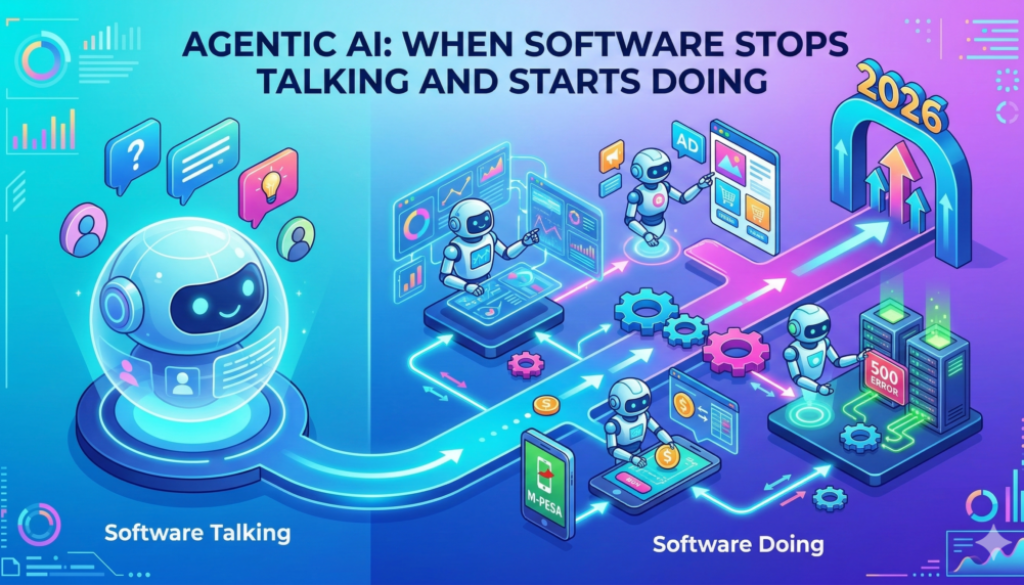
Agentic AI: When Software Stops Talking & Starts Doing 2026
For the past few years, the tech world has been captivated by AI that can write emails, summarize PDFs, and generate boilerplate code. But as we navigate 2026, the landscape has decisively shifted. We are moving beyond conversational interfaces that simply wait for human instructions and entering the era of Agentic AI—where software stops just talking and starts executing.
This isn’t just an incremental update; it’s a fundamental rewiring of how applications operate. 2026 is the year we fully transition from single-prompt LLMs to autonomous multi-agent systems capable of handling complex, multi-step workflows.
Here is what that means for the future of software, business automation, and the developers building it.
The 2026 Turning Point: Multi-Agent Systems (MAS)
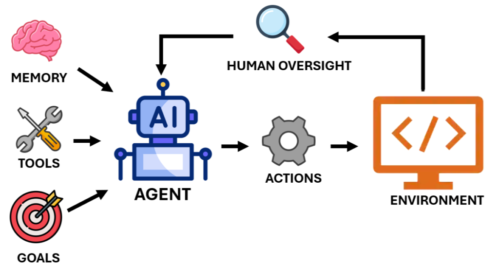
Early generative AI was a digital assistant. You asked a question, and it provided an answer. Agentic AI, on the other hand, is a digital workforce. Instead of relying on a single model to do everything, modern architectures utilize Multi-Agent Systems (MAS) where specialized, autonomous agents collaborate to achieve a broader goal.
Consider the architecture of a modern, modular retail solution like Uptraq POS. In a traditional setup, adapting the core system for a beauty shop client requires writing entirely new, hardcoded modules for tracking product expiry dates and routing wholesale approval workflows.
In an agentic ecosystem, you deploy specialized AI agents. One agent autonomously monitors inventory lifecycles and flags expiring products, while a separate financial agent orchestrates the wholesale approval workflow in real-time. They communicate, negotiate, and execute the required actions without a human manually triggering a script or navigating a dashboard.
The Developer Paradigm Shift: Defining Intent Over Logic
For software engineers, the rise of Agentic AI changes the very nature of development. We are shifting away from writing rigid, procedural code toward intent-based development.
Instead of programming the exact how, developers are now programming the what.
Think about the tedious process of debugging a live application. Instead of manually SSHing into a server to run tail -n 20 error_log or firing off php artisan config:clear every time a 500 Internal Server Error disrupts a server-side rendered Blade view, a developer delegates this to an infrastructure agent. The assigned intent is simply: “Maintain 99.9% uptime and auto-resolve server-side rendering faults.” The agent detects the anomaly, diagnoses the logs, executes the cache-clearing commands, and verifies the resolution entirely on its own.
This paradigm is especially powerful for complex financial integrations. When building automated M-Pesa collection solutions for Chama collectives, the traditional approach involves writing brittle scripts to parse APIs and update databases. With Agentic AI, the developer defines a strict business rule: “Ensure dashboard revenue strictly reflects actual cash collected, isolating unpaid billed amounts.” The financial agent continually ingests the M-Pesa data streams, autonomously applies this logic to reconcile the accounts, and keeps the dashboard flawlessly accurate.
Real-World Impact: Automating the Unpredictable
The true power of Agentic AI lies in its ability to handle dynamic, unpredictable environments where traditional “if/then” logic breaks down. By delegating task orchestration to AI, businesses can scale operations in ways that were previously impossible without massive human capital.
For instance, in US electronics retail marketing, an agentic workflow can autonomously monitor real-time ad performance across different time zones and demographics. If the agent notices that premium laptops priced above $1,500 are experiencing high bounce rates during a specific promotional window, it doesn’t just send an alert to the marketing team. It dynamically adjusts the Google Merchant Center feeds and Meta ad targeting to focus strictly on the high-performing $600 to $1,100 price range, seamlessly reallocating the budget and launching a highly optimized campaign with zero manual intervention.
The Future is Autonomous
As we push further into 2026, the question is no longer whether AI can write the code, but whether your architecture is ready to let AI run the system. By embracing multi-agent frameworks and intent-based design, businesses can deploy software that doesn’t just assist with the workload—it actively completes it.