Desert Bloom 2.0: Inside the UAE Vertical Farming Market 2026
If you walked into a high-end supermarket in Dubai or Abu Dhabi just a decade ago, almost every fresh item in the produce section held a passport. The leafy greens were flown in from the Netherlands, the berries were shipped from the Americas, and the tomatoes spent weeks in cold-chain logistics across the Mediterranean. The harsh reality of the desert climate meant that the United Arab Emirates historically imported roughly 85% to 90% of its food.
But as we settle into the first quarter of this year, that old narrative is officially dead.
When you analyze the UAE vertical farming market 2026, one thing becomes immediately clear: the Emirates have stopped trying to simply survive their climate and have instead engineered their way out of it entirely. We are witnessing the ultimate decoupling of food production from physical geography. Through a relentless combination of sovereign wealth capital, hyper-advanced robotics, and aggressive government policy, the UAE isn’t just buying food security anymore—it is actively manufacturing it.
Here is an inside look at the technologies, the massive infrastructure projects, and the shifting retail economics that are defining the UAE vertical farming market 2026, transforming a desert nation into the undisputed global capital of agricultural technology.
I. The 2026 Harvest: Decoupling Food from Geography
Late March has brought a historic tipping point to the region’s retail sector. For the very first time, “Zero-Mile” produce—vegetables that are grown, harvested, packaged, and sold within a strict 50-kilometer radius—is actively outperforming international imports in the premium retail sector.
The numbers behind the UAE vertical farming market 2026 are staggering. The sector has surged to an estimated valuation of $484 million this year alone, and it is compounding at a relentless 15% CAGR. But to truly understand this shift, we have to look past the financial metrics and understand the operational maturity of the industry.
This is no longer about quaint “indoor gardening” or experimental shipping container farms set up in industrial parks. The experimental days are over. In 2026, the UAE has officially moved out of the “pilot phase” and aggressively entered the Industrial Scaling Phase. The infrastructure being deployed today rivals modern semiconductor manufacturing plants in both scale and technological sophistication. This transition perfectly aligns with the government’s long-term , which aims to make the UAE the world’s leading hub in innovation-driven food security.
II. The “GigaFarm” and the Maturation of Food Tech Valley
The undisputed centerpiece of this national agricultural revolution is the Food Tech Valley located in Dubai. Launched years ago as an ambitious blueprint, the reality of the project has finally caught up to the hype. By March of this year, the crowning jewel of the valley—the “GigaFarm” project—has moved into its absolute operational peak.
Spanning a massive 0.08 square kilometers, the GigaFarm is a marvel of modern biological engineering.
Scale Beyond the Warehouse
It is crucial to understand that the GigaFarm is not merely a warehouse outfitted with some LED lights and water pumps; it is a meticulously balanced, closed-loop ecosystem. The facility was designed from the ground up to completely replace thousands of tons of imported leafy greens, effectively neutralizing the carbon footprint associated with flying highly perishable goods halfway across the globe.
The Aeroponic Advantage
The technological backbone driving the UAE vertical farming market 2026 is advanced aeroponics. Unlike traditional hydroponics (where roots sit in flowing water), aeroponics suspends the plant roots entirely in the air. A precisely calibrated, nutrient-dense mist is periodically sprayed directly onto the root systems.
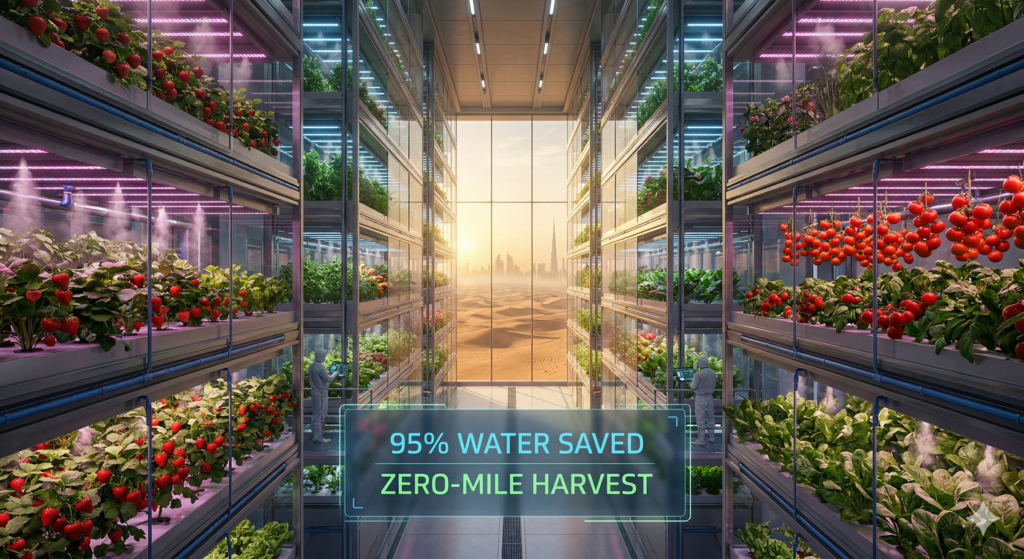
The efficiency gains here are difficult to overstate. This method utilizes 95% less water than traditional open-field farming—a critical metric in a water-scarce region that relies heavily on energy-intensive desalination. Furthermore, because the plants receive the exact macronutrients they need without having to expend energy growing massive root networks to search for food in soil, the GigaFarm produces yields up to 300 times higher per square meter than a conventional farm.
The “Zero-Waste” Circular Model
Perhaps the most impressive aspect of the GigaFarm is its strict adherence to the 2026 “Circular Economy” mandate, which is now the baseline operational standard across the UAE. The facility operates on a genuine zero-waste model. Any biological waste, unsold organic matter, or root byproducts from the farm are systematically collected and converted on-site back into either usable biofuel energy or high-grade compost. This closed-loop system ensures that the facility feeds itself, minimizing external inputs and drastically lowering long-term operational costs.
III. Abu Dhabi’s AgTech Park: The R&D Science Engine
While Dubai is heavily focused on massive commercial scale and output, the neighboring emirate of Abu Dhabi has positioned itself as the hard science and R&D engine driving the UAE vertical farming market 2026.
The ADQ AgTech Park, situated in the traditionally agricultural region of Al Ain, has reached full operational status this quarter, and the scientific breakthroughs emerging from this hub are reshaping global agronomy.
The 40,000sqm Expansion
In a massive strategic partnership with leading European technology firms, including Italy’s ZERO, the Al Ain park recently completed a 40,000-square-meter expansion. The facility is now churning out over 40 kilotons of fresh fruits and vegetables annually. To put that into perspective, that single facility is now supplying roughly 6% of the entire country’s domestic consumption for those specific crops.
Moving Beyond the Lettuce Barrier
For years, the major critique of the indoor farming industry was its heavy reliance on easy-to-grow leafy greens. Lettuce and spinach are great, but you cannot feed a nation on salads alone.
This is why 2026 is such a landmark year. The UAE vertical farming market 2026 has finally conquered the complex crop barrier. Through advanced climate manipulation and specialized pollination robotics (since there are no bees indoors), we are now seeing locally grown, ultra-premium strawberries, vine-ripened tomatoes, and even highly sensitive cash crops like saffron hitting the shelves. You can now walk into Spinneys or Waitrose and buy a perfectly ripe, locally grown punnet of strawberries in the middle of July, completely indifferent to the 45°C heat radiating outside the supermarket doors.
The Era of the “Smart” Seed
The most groundbreaking work happening in Al Ain, however, isn’t just about how the plants are grown, but what is being grown. Researchers are aggressively deploying AI-driven precision phenotyping.
Historically, agricultural seeds were bred to survive the harsh, unpredictable outdoors—they were bred for drought resistance, pest immunity, and thick skins to survive transport. But indoors, there are no pests, there are no droughts, and the climate is mathematically perfect.
Therefore, Abu Dhabi’s scientists are developing “2026 Seeds”—genetics specifically optimized for highly controlled, LED-lit environments. Because these plants don’t need to waste biological energy building defenses against a hostile natural world, all of their energy goes into rapid growth and flavor development. These proprietary seeds grow 20% faster, yield incredibly consistent produce, and boast a significantly higher nutrient density than their field-grown, imported alternatives.
IV. The Retail Economics: The “Zero-Mile” Premium
All of this incredible infrastructure and scientific advancement ultimately culminates at the consumer level. For the everyday UAE resident, the maturation of the UAE vertical farming market 2026 is vividly apparent in the retail grocery aisles, and it is changing the way people shop.
The “UAE Sustainable Harvest” Label
Transparency and origin tracing have become paramount for the 2026 consumer. Today, premium produce sections are dominated by the “UAE Sustainable Harvest” seal. This isn’t just a marketing sticker; it is an integrated digital tag, typically utilizing a secure QR code linked to a blockchain ledger.
When a shopper scans this label, they aren’t just told the produce is “local.” They are shown the exact vertical farming hub where the salad was grown, the precise nutrient mix it received, and the exact hour it was harvested. Because these farms are located within the city limits, that harvest time is usually less than 24 hours prior to the scan. The crispness, flavor, and shelf-life of produce cut that morning simply cannot be matched by organic greens that have spent six days in a refrigerated shipping container from Europe.
Achieving True Price Parity
For a long time, the barrier to entry for locally grown agritech produce was the premium price tag. The high capital expenditure of building the farms and the massive electricity requirements to power the LEDs kept prices high.
However, a major milestone for the UAE vertical farming market 2026 is the achievement of true price parity. A combination of factors has driven retail prices down to aggressively compete with traditional imports. First, the widespread integration of massive solar grids and highly subsidized renewable energy rates for AgTech companies has slashed the cost of electricity. Second, and more importantly, local farms completely bypass the exorbitant, volatile costs of international cold-chain logistics, customs tariffs, and supply chain shrinkage (spoilage during transit).
In 2026, choosing “Local” is no longer an expensive luxury reserved for the ultra-wealthy. It has become the baseline, high-quality, and economically sensible choice for the average household.
Conclusion: Exporting the Future
The evolution of the UAE vertical farming market 2026 represents a massive geopolitical shift. By investing heavily in the Food Tech Valley, the Al Ain AgTech Park, and advanced biological R&D, the Emirates have neutralized one of their most significant historical vulnerabilities: food dependency.
But the vision extends far beyond domestic food security. The UAE is rapidly moving from being a net importer of food to becoming a net exporter of agricultural technology. The proprietary software, the closed-loop circular systems, and the optimized “2026 Seeds” developed in the desert are now being licensed and exported to other climate-stressed regions around the globe, from arid parts of Australia to the changing climates of the American Southwest. The desert is blooming, and the rest of the world is taking notes.